My Experience at the India FOSS conference
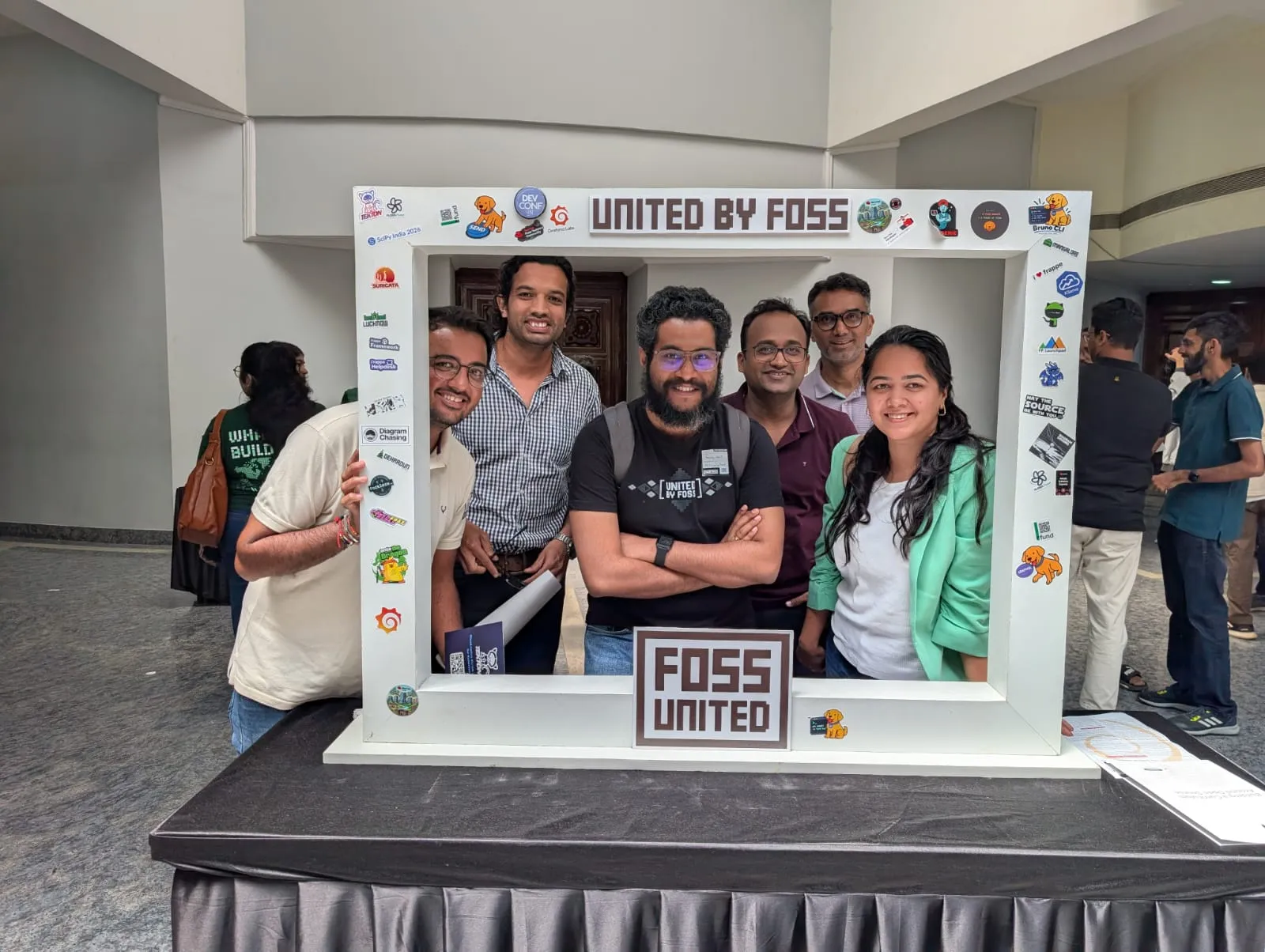
This was the 3rd time I attended India FOSS. I was quite involved with India FOSS ever since I heard about them when I attended the Open Source India conference. It was 2024 when I first attended the India FOSS conference and it blew my mind. One of the main things that caught my eye was the open source hardware that was at the booths and also the talks.
Why not Open Source India?
Section titled “Why not Open Source India?”One of the things I really disliked about the Open Source India conference was that it was heavily geared towards commercial entities. The whole conference was sponsored by top tech orgs like Google, Amazon, Shell (which is not even a software company) who were there. While those orgs do fund many open source projects and teams there’s very less representation of the open source communities at the conference. What’s even worse is that these conferences have these companies who are awarded sponsor talks. This leads to talks that favour such companies. For eg: Shell spoke about how Rust as a programming language consumes very few resources on the cloud and how it is good for the environment. This sounded to me like a narrative where the company whose primary business is around fossil fuel are trying to greenwash their image.
The community at India FOSS
Section titled “The community at India FOSS”Stepping into a conference like India FOSS is the exact opposite. While you won’t get fancy food at the buffet for lunch. The simple food at the conference is worth what you get to see and enjoy. There’s a lot of different communities that come together with a lot of the crowd being very young and quite a few of them are even students. Apart from that there are local meetup communities who are there at the conference in order to represent their communities at the conference. And these communities are from all over the country like FOSS United Mangalore, Open Data Kerala, VGLUG Foundation etc.
The hardware booths
Section titled “The hardware booths”Among the booths that are there at the conference, the ones that really steal my heart are the hardware booths. This year the hardware booths were a bit less impressive than the ones last year. But some of my favourites were absurd.industries and PCB Cupid who are doing some of the most amazing work at the conference. There’s also Mecha which is a hand held Linux based computer which did not have a booth this year.
Absurd Industries has some absurd projects like the Cory Dora which is a Macropad with a small display; which can be customised and configured for your use case. They also make a LED lamp called Lampy which is a desk lamp and has a nice 3d printed cover which lights up in a beautiful way. Then there’s PCB Cupid who had a range of development boards for microcontroller and other hardware projects. And the last thing I liked in open source hardware were the little cute robots from Whybit called T-01 The Explorer. These are mini desk robots which can be remote controlled via a remote controller or be programmed to explore on their own.
Solstone, the second brain
Section titled “Solstone, the second brain”While most of these things at the conference were non-AI; there was another AI thing that really impressed me. I always thought of building a second brain for myself using AI so that I can off-load some of my brain power. The thing that I was dreaming about was right there, called Solstone. Solstone is an AI powered and privacy focused journal which can store, organise and recall your activities throughout the day and of the past days. This makes it easy to plan and recall important activities and events that took place in your life. What makes Solstone special is the focus on privacy and hosting and running the app privately on your own machine.
The talks
Section titled “The talks”The talks this year were also quite good, I liked the hardware talks esp. The one on Keyboard keyboard firmware called ZMK/QMK and how to build your own keyboard from scratch. And also the CNC4Everyone where they build a cheap, cost effective CNC machine but is very useful and which could be used for school students to learn. I really liked the quote that was made by the speaker of the talk but was originally by Balu Babu, “China can fill a stadium with CNC operators, We can barely fill a classroom… This isn’t just about having the right tools, it’s about having enough people who know how to use them effectively. And that gap affects everything from quality to innovation speed.”
I also liked the panel discussion around AI and Open Source and the discussion touched on a lot of topics like what should students do in the world of AI and how careers are shaped in that world. Kailash Nadh the CTO of Zerodha, one of the sponsors of the India FOSS conference also told how he uses AI/LLM for daily coding and how the team at Zerodha uses AI/LLM. They also made some predictions on how AI/LLM is going to change things in its path. But I could conclude from this panel discussion that no one knows what’s happening and how it’s changing the world, and what’s eventually gonna happen to the world with the deep penetration of AI.
Composing music with Strudel
Section titled “Composing music with Strudel”Lastly I really loved the workshop on music composition using strudel.cc by Azan, where he shared a bunch of code snippets which explained how to compose music with strudel.cc and how to do so. The tool was quite impressive and opened my eyes to what is possible with strudel that would help me compose music. The use of this tool is only limited by my ability and knowledge of music theory and playing any instrument.
Conclusion
Section titled “Conclusion”Overall the conference was really good. The booths were not as good as last time, but that might just be my feeling. The food was also way better than last time. Overall I had a lot of fun at the conference and I would like to declare the conference as a success.